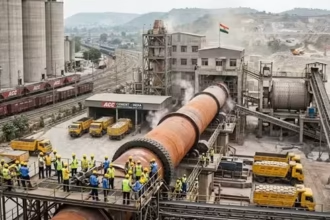
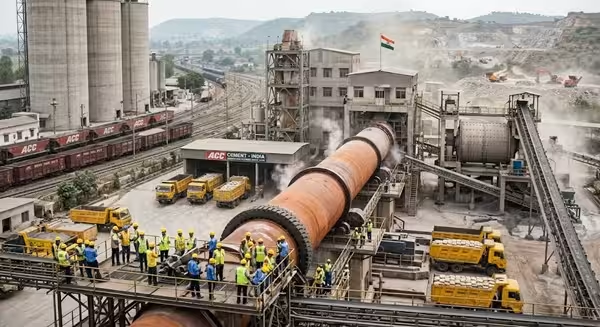
India does not have a single manufacturing story. On one side are enormous steel mills, automobile plants, refineries and cement factories; on another are thousands of MSMEs producing components, textiles, machinery and consumer goods. A newer layer is now developing around smartphones, semiconductors, electric vehicles, renewable-energy equipment and advanced electronics. Together, these very different factories form the manufacturing base India is trying to turn into a much larger part of its economy.
Heading into 2027, that transformation is gathering momentum. Manufacturing GVA grew 11.6% in FY2025-26, while the sector contributes roughly 16–17% of India’s GDP under broader estimates. India’s policy focus has increasingly shifted from simply producing goods domestically toward increasing local value addition, exports, technology adoption and participation in global supply chains. The National Manufacturing Mission aims to eventually raise manufacturing’s GDP contribution to 25%.
| Quick Information | Details |
|---|---|
| Sector | Manufacturing |
| Country | India |
| Contribution to GDP | Around 16–17% |
| Manufacturing GVA Growth (FY26) | 11.6% |
| Manufacturing Employment | More than 27 million workers |
| Major Industries | Automobile, electronics, steel, chemicals, pharmaceuticals, textiles, cement and machinery |
| Major Manufacturing States | Gujarat, Maharashtra, Tamil Nadu, Karnataka, Uttar Pradesh, Telangana and others |
| Key Growth Areas | Electronics, semiconductors, EVs, defence, renewable energy and advanced manufacturing |
| Major Policy Drivers | Make in India, PLI Schemes, National Manufacturing Mission, PM GatiShakti |
| Major Challenges | Logistics, skills, technology gaps, import dependence and global competition |
How Large Is India’s Manufacturing Sector?
Manufacturing is one of the fundamental pillars of the Indian economy because it converts agricultural, mineral and industrial inputs into higher-value products.
Government data released in 2026 showed manufacturing accounting for approximately 14.8% of total GVA at current prices in FY2025-26 under India’s revised national accounts series. Broader GDP-based industry estimates commonly put its contribution at around 16–17%.
More importantly, manufacturing output has been expanding.
Manufacturing GVA grew approximately 11.6% during FY2025-26, compared with 8.3% during FY2024-25.
The sector also employs more than 27 million workers, making manufacturing important not only for economic output but also for India’s employment ambitions.
Major Manufacturing Industries in India
India’s manufacturing ecosystem contains several industries large enough to be major economic sectors independently.
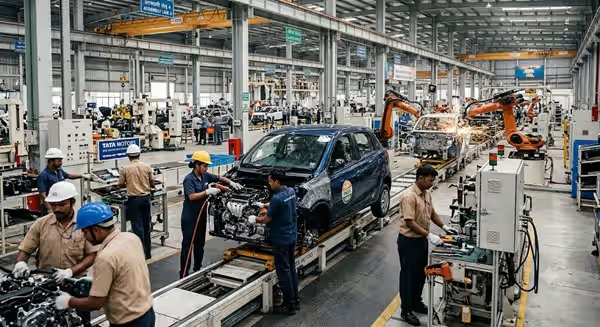
Automobile manufacturing covers passenger cars, two-wheelers, commercial vehicles, three-wheelers and a large auto-component ecosystem.
Iron and steel provides essential materials for infrastructure, automobiles, engineering and construction.
Pharmaceutical manufacturing has established India as one of the world’s leading suppliers of generic medicines.
Chemicals and petrochemicals supply materials used across agriculture, textiles, pharmaceuticals, packaging and consumer goods.
Textile and apparel manufacturing connects agriculture and industrial production while providing large-scale employment.
Cement supports housing and infrastructure construction.
A newer growth engine is electronics and semiconductor manufacturing, where India is attempting to develop deeper domestic supply chains rather than depending mainly on imported components.
Electronics Shows How Indian Manufacturing Is Changing
Electronics provides one of the clearest examples of India’s transition toward higher-value manufacturing.
Electronics exports increased from approximately ₹38,000 crore in FY15 to ₹3.27 lakh crore in FY25, while the sector created an estimated 25 lakh jobs over the decade.
Domestic value addition in electronics has also increased substantially. India is no longer focused only on assembling imported components; policy is increasingly directed toward components, semiconductors and supporting supply chains.
Smartphones have become particularly important. Cumulative smartphone production under the PLI programme reached approximately ₹6.66 lakh crore in FY2025-26.
The challenge for the next stage is to replicate this progress across components, semiconductor devices, industrial electronics and other sophisticated products.
What Is Driving Manufacturing Growth in India?
India’s enormous domestic market gives manufacturers something many export-oriented manufacturing economies do not have: a large customer base at home.
Rising incomes can increase demand for vehicles, appliances, electronics, packaged consumer goods, construction materials and other manufactured products.
Infrastructure investment also stimulates manufacturing indirectly. New highways, freight corridors, ports and industrial parks improve logistics while simultaneously generating demand for steel, cement, machinery and electrical equipment.
Foreign investment provides another source of growth. India’s gross FDI inflows reached a record US$94.53 billion during FY2025-26, an increase of approximately 17% year-on-year.
Manufacturing-related FDI has also expanded considerably over the past decade.
Make in India and PLI Schemes
Government industrial policy remains an important part of India’s manufacturing strategy.
Make in India seeks to encourage domestic and international businesses to manufacture more products within the country.
Production Linked Incentive schemes take a more targeted approach. PLI programmes cover 14 strategic sectors with an overall outlay of approximately ₹1.91 lakh crore.
By December 2025, these schemes had attracted investments exceeding ₹2.16 lakh crore, generated incremental production of more than ₹20.41 lakh crore and supported over 14.39 lakh jobs.
The National Manufacturing Mission provides a broader long-term framework. It aims to increase manufacturing’s share of GDP to 25% by 2035 while strengthening MSMEs, skills, technology adoption and India’s integration into global value chains.
Key Players in Indian Manufacturing
Because manufacturing covers dozens of industries, there is no meaningful single ranking of India’s largest manufacturing companies.
Instead, different companies lead different sectors.
Reliance Industries has major manufacturing operations in refining and petrochemicals.
Tata Group companies participate across automobiles, steel, electronics and several other manufacturing businesses.
Mahindra & Mahindra and Maruti Suzuki are important automobile manufacturers.
JSW Steel and SAIL are major steel producers, while UltraTech Cement is India’s largest cement manufacturer.
Companies such as Sun Pharma, Dr. Reddy’s Laboratories and Cipla represent India’s large pharmaceutical manufacturing ecosystem.
India also has millions of MSMEs supplying components, machinery, textiles, fabricated products and intermediate goods to larger manufacturers.
Future Scope of Manufacturing Industries in India
The next phase could be increasingly driven by advanced manufacturing rather than only traditional industrial production.
Semiconductor fabrication and packaging can strengthen India’s electronics supply chain.
Electric vehicles create opportunities in batteries, motors, power electronics and automotive components.
Renewable energy can support domestic manufacturing of solar modules, wind-energy equipment, batteries and electrical infrastructure.
Defence and aerospace manufacturing could also become more significant as India attempts to increase domestic production and exports.
Automation, robotics, artificial intelligence and Industry 4.0 technologies may improve productivity across existing factories.
India also has an opportunity to capture manufacturing being diversified across multiple countries as global businesses reconsider supply-chain concentration.
Challenges Facing Indian Manufacturing
India still needs to improve its competitiveness against established manufacturing economies.
Logistics and infrastructure costs can affect manufacturers that depend on moving raw materials and finished products across long distances.
Import dependence remains significant in areas such as semiconductor equipment, electronic components, specialised machinery and certain industrial raw materials.
Another challenge is the availability of workers with the specialised skills required for advanced factories.
India must also improve research, product development and intellectual property creation. Manufacturing imported designs domestically creates value, but developing globally competitive Indian technologies can generate substantially greater long-term benefits.
Finally, environmental sustainability will increasingly influence industrial investment. Manufacturers will need cleaner electricity, efficient equipment, recycling, lower emissions and better resource management as production expands.
FAQs
Q1. How big is India’s manufacturing sector?
A. Manufacturing contributes roughly 16–17% of India’s GDP under broader industry estimates. Manufacturing GVA recorded strong growth of approximately 11.6% during FY2025-26.
Q2. What are the major manufacturing industries in India?
A. Major industries include automobiles, electronics, iron and steel, pharmaceuticals, chemicals, textiles, cement, food processing, machinery, petroleum products and increasingly semiconductors, renewable-energy equipment and defence products.
Q3. Which companies are major manufacturing players in India?
A. Major manufacturers vary by sector. Examples include Reliance Industries, Tata Group companies, Maruti Suzuki, Mahindra & Mahindra, JSW Steel, SAIL, UltraTech Cement, Sun Pharma, Dr. Reddy’s Laboratories and numerous other large and mid-sized companies.
Q4. What is the future scope of manufacturing in India?
A. India’s strongest opportunities include electronics, semiconductors, electric vehicles, batteries, renewable-energy equipment, defence and aerospace, advanced machinery and higher-value exports. Government policy is targeting a manufacturing contribution of 25% of GDP by 2035, although achieving that ambition will require continued improvements in productivity, skills, logistics, technology and domestic value addition.