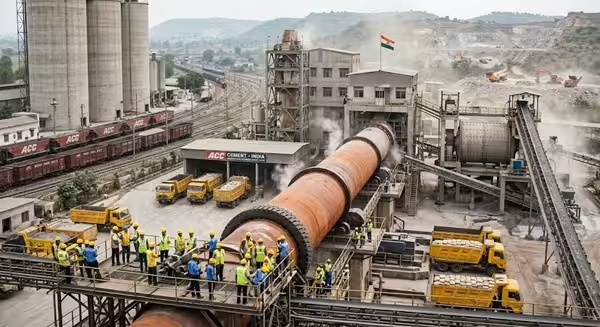
When construction accelerates in India, cement plants feel the effect quickly. A highway expansion in one state, new housing on the outskirts of a Tier-II city and a metro project hundreds of kilometres away can all create demand for the same basic building material. Yet cement is heavy and relatively costly to transport over long distances, which makes the location of limestone reserves, manufacturing plants, grinding units and customers particularly important to how this industry grows.
India enters 2027 as the world’s second-largest cement producer, supported by close to 700 million tonnes per annum (MTPA) of installed capacity. Cement production increased 8.6% year-on-year to 491.4 million tonnes in FY2025-26, while the latest ICRA outlook expects volumes to grow another 6–7% during FY2026-27. Housing, roads, railways and other infrastructure projects remain the industry’s primary demand engines.
| Quick Information | Details |
|---|---|
| Industry | Cement Industry |
| Country | India |
| Global Position | 2nd-largest cement producer |
| FY26 Cement Production | About 491.4 million tonnes |
| FY27 Expected Volume Growth | Around 6–7% |
| Installed Capacity | Over 700 MTPA |
| Major Producing Regions | South, North, East, West and Central India |
| Major Players | UltraTech Cement, Ambuja Cements, ACC, Shree Cement, Dalmia Bharat, JK Cement |
| Main Demand Sources | Housing, roads, railways, commercial construction and infrastructure |
| Major Challenges | Energy costs, freight, emissions, overcapacity and price competition |
Size of the Cement Industry in India
India’s cement industry has expanded considerably as construction and infrastructure investment have increased.
Production reached approximately 491.4 million tonnes during FY26, compared with about 453 million tonnes in FY25. This represents annual growth of 8.6%. Production remained strong at the beginning of FY27, reaching approximately 212.1 million tonnes during the first five months, up about 10.3% year-on-year.
Installed capacity is much higher than actual annual production. Industry estimates put India’s cement capacity at more than 700 MTPA, with newer estimates placing grinding capacity around 720–730 MT as of March 2026.
India also accounts for more than 8% of global installed cement capacity, demonstrating the scale the domestic industry has already achieved.
Where Is Cement Manufactured in India?
Unlike IT or pharmaceutical manufacturing, cement plants cannot be located solely according to access to skilled workers or large cities.
Limestone availability plays a major role because limestone is the principal raw material used in cement production. Consequently, manufacturing capacity has developed strongly in states with suitable mineral resources.
Andhra Pradesh, Rajasthan, Tamil Nadu and Karnataka are among India’s important cement-producing states.
Southern India accounts for approximately 32% of installed capacity, making it the country’s largest regional cement market by capacity. North and East India each account for roughly 20%, followed by West India at around 15% and Central India at approximately 13%.
Grinding units can be located closer to consumption centres, helping companies reduce transportation requirements for finished cement.
What Is Driving Cement Demand in India?
Housing is one of the largest sources of cement consumption.
India continues to require new urban and rural homes, while government programmes such as the Pradhan Mantri Awas Yojana support additional housing construction.
Infrastructure provides the other major demand pillar.
Roads require cement for bridges, tunnels, flyovers and concrete structures. Railways consume cement through stations, tracks, bridges and large infrastructure projects. Metro systems, airports, industrial corridors and urban infrastructure create additional demand.
The scale of individual projects can be substantial. The Mumbai-Ahmedabad Bullet Train Corridor, for example, has been consuming around 20,000 cubic metres of cement per day during construction.
The Union Budget 2026-27 also allocated approximately ₹12.2 lakh crore toward public capital expenditure, supporting continued infrastructure construction.
Major Cement Companies in India
India’s cement market has become increasingly concentrated among large producers.
UltraTech Cement is the country’s largest cement manufacturer. In April 2026, it crossed 200 MTPA of domestic installed capacity, strengthening its position as the largest cement producer outside China by capacity and sales volume.
Ambuja Cements, together with ACC and other cement assets under the Adani portfolio, has also expanded aggressively.
Shree Cement remains another major producer with a strong presence across several regional markets.
Dalmia Bharat is expanding its manufacturing network and is targeting approximately 75 MTPA of capacity by FY28.
Other important companies include JK Cement, The Ramco Cements, Birla Corporation, JK Lakshmi Cement and Nuvoco Vistas.
The private sector controls around 98% of India’s cement capacity, while the top 20 companies account for roughly 70% of total production.
Capacity Expansion and Industry Consolidation
Indian cement manufacturers are investing heavily in additional capacity.
CRISIL Ratings expects around 150–160 MT of capacity additions between FY25 and FY28. Major manufacturers are investing in both new plants and acquisitions to increase their geographical reach.
Consolidation has consequently become one of the industry’s defining trends.
Large producers can benefit from economies of scale, stronger distribution networks, improved logistics and the ability to operate plants across multiple regional markets.
However, aggressive capacity expansion introduces another risk: supply could temporarily grow faster than demand.
Industry estimates indicate that capacity additions may exceed demand growth during FY27 and FY28, potentially creating pricing pressure and reducing utilisation in some regional markets.
Future Scope of India’s Cement Industry
India’s long-term cement opportunity remains closely connected to the country’s urbanisation and infrastructure requirements.
Installed capacity is projected to reach approximately 850 MTPA by 2030, compared with around 700 MTPA currently.
Eastern and central India could become increasingly important growth markets as infrastructure connectivity, industrial development and housing activity expand.
Export opportunities also exist. Coastal plants can potentially supply clinker and cement to markets in the Middle East, Africa and other developing regions.
Another important opportunity is premium and specialised cement. Manufacturers are increasing their focus on value-added products rather than competing entirely through conventional cement volumes.
Green Cement and Sustainable Manufacturing
Sustainability will have an increasingly large influence on the industry because conventional cement production is carbon-intensive.
Manufacturers are investing in renewable electricity, waste-heat recovery systems, alternative fuels and more efficient production technology.
Carbon capture could eventually become another tool for reducing emissions. In December 2025, Ambuja Cements was selected for an Indo-Swedish carbon capture and utilisation pilot project.
Companies are also increasing the use of blended cement, which can reduce the proportion of emission-intensive clinker required in the final product.
The ability to manufacture cement with a lower carbon footprint may eventually become an important competitive advantage, particularly for infrastructure developers and companies with sustainability targets.
Challenges Facing India’s Cement Industry
Energy costs are one of the industry’s biggest concerns. Cement production requires substantial heat and electricity, making profitability sensitive to coal, petcoke and power prices.
Freight costs are equally important because cement is heavy and expensive to transport relative to its value.
Rapid capacity expansion creates another challenge. If production capacity grows significantly faster than consumption, manufacturers may face lower utilisation and stronger price competition.
Environmental pressure is also increasing. Cement plants must reduce emissions, manage dust, improve energy efficiency and lower their carbon intensity.
Finally, the industry’s profitability can fluctuate even when volumes are increasing. ICRA expects FY27 operating margins to face pressure from higher fuel, freight and other input costs.
FAQs
Q1. How big is India’s cement industry?
A. India produced approximately 491.4 million tonnes of cement in FY2025-26, an increase of 8.6% over the previous year. Installed cement capacity is above 700 MTPA.
Q2. Which is the largest cement company in India?
A. UltraTech Cement is India’s largest cement producer. Its domestic installed manufacturing capacity crossed 200 MTPA in April 2026.
Q3. Which are the major cement companies in India?
A. Major companies include UltraTech Cement, Ambuja Cements, ACC, Shree Cement, Dalmia Bharat, JK Cement, The Ramco Cements, Birla Corporation and Nuvoco Vistas.
Q4. What is the future of India’s cement industry?
A. India’s cement industry has substantial long-term growth potential because of housing, highways, railways, urban development and other infrastructure investment. Installed capacity is projected to reach around 850 MTPA by 2030, while sustainability, consolidation and specialised cement products are likely to become increasingly important.